

Wire shelving sags, rusts, and fails faster in Florida than almost anywhere else in the country. That’s not a coincidence. It’s a direct result of building a low-cost, one-size-fits-all product for a climate it was never designed to handle.
Why Does Wire Shelving Sag and Fail in Florida Closets?
Wire shelving is rated for light, evenly distributed weight, typically far less per linear foot than solid shelving. Once it’s loaded with folded sweaters, stacked shoe boxes, or seasonal storage, it bows in the middle within a couple of years. The wire coating also breaks down over time, especially in humid conditions, which weakens the structure further. It’s the standard finish in new construction because it’s inexpensive to install at scale, not because it holds up long term.
How Does Humidity Affect Closet Shelving in Florida?
Florida’s humidity accelerates almost every failure mode builder-grade shelving has. Particleboard shelving swells and warps. Wire coatings corrode faster near coastal areas with salt air exposure. Brackets mounted into drywall (rather than studs) pull loose as moisture affects the wall material around them. A closet that looked fine at move-in can show visible sagging and separation within 18 to 36 months, especially in homes near the Gulf Coast.
Materials science resources on wood moisture content note that hot, humid climates like Florida typically sit around 80 percent relative humidity, which pushes untreated wood and particleboard well past the moisture levels they were designed to handle. That’s a meaningfully harsher environment than the shelving in most national home-building catalogs was ever tested for.
What Should You Replace Wire Shelving With?
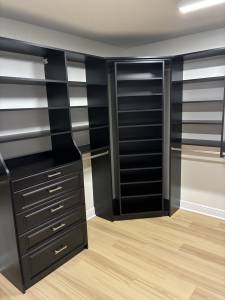
Solid shelving made from moisture-resistant materials, mounted directly to wall studs rather than surface-anchored to drywall. Laminate and thermofoil finishes resist humidity, warping, and rust significantly better than wire or particleboard, and they hold far more weight without bowing. This is the same underlying construction whether the space is a bedroom closet, a pantry, or a garage. The material and mounting method matter more than the room.
Signs it’s time to replace wire shelving before it fails completely:
- Visible sagging or bowing in the middle of a shelf
- Rust spots or corrosion on wire coating, especially in coastal homes
- Brackets pulling away from the wall or feeling loose to the touch
- Shelving that was installed within the last two to three years and already looks worn
How Long Does a Wire Shelving Replacement Take?
Most reach-in closet replacements take 2 to 3 hours once the new system is manufactured and ready for installation. Walk-in closets typically take 4 to 6 hours. The wait before installation is usually 6 to 8 weeks for laminate finishes and 8 to 10 weeks for wood, since everything is built to the exact dimensions of your space rather than pulled off a shelf.
This Problem Isn’t Unique to One City
Builder-grade wire shelving shows up the same way across Florida’s Suncoast, just in different housing stock. Coastal condos in Sarasota, including Siesta Key and Lido Beach, deal with salt air accelerating corrosion. Newer developments throughout Lakewood Ranch and Bradenton often have wire shelving that starts sagging within the first three years of a new build. And fast-growing communities around Wellen Park and Venice face the same builder-grade standard in nearly every new construction closet.
Replacing wire shelving with a custom system, manufactured locally in our Clearwater facility and professionally installed, solves the problem once instead of every few years. This applies just as much to pantries and garages as it does to bedroom closets. If you’re weighing a full storage overhaul, see our guide to custom closets vs. cabinets to figure out where to start.
Schedule a free in-home consultation to see what’s actually possible in the space you already have.


